

The short answer
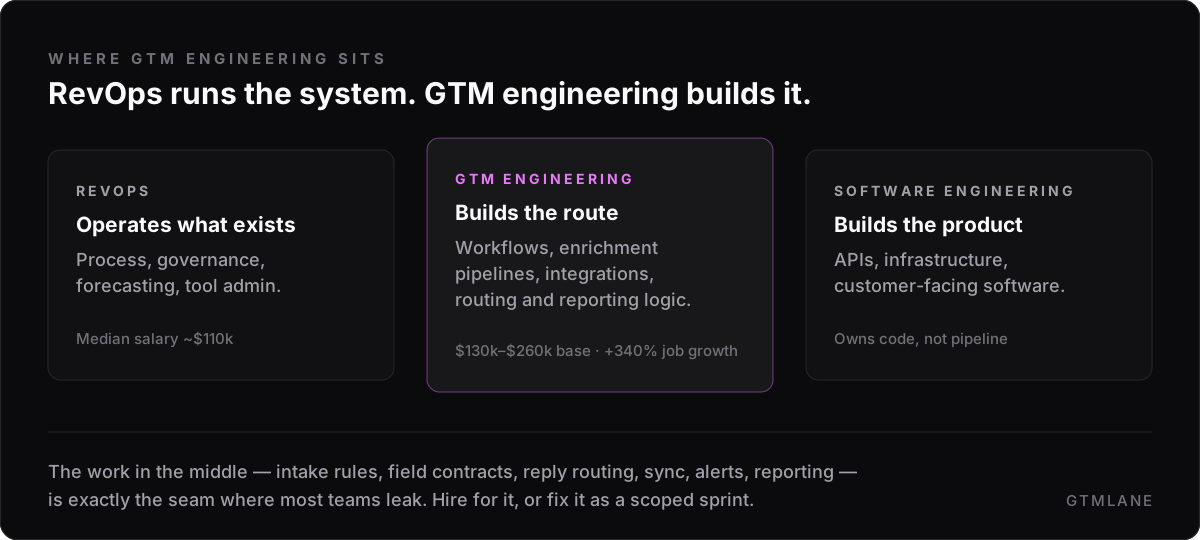
GTM engineering is the discipline of building the systems that move leads between your go-to-market tools — enrichment pipelines, routing logic, integrations, and reporting. It sits between RevOps (which operates what exists) and software engineering (which builds the product). You need the work in every outbound stack; whether you need the hire depends on how much net-new building your motion demands.
Two years ago the title barely existed. Today it’s the fastest-growing role in go-to-market: GTM engineering job postings grew roughly 340% year over year, with thousands of open roles and base salaries that have pushed past many senior sales positions. The trigger was a generation of programmable GTM tools — Clay above all, which shows up in over 90% of GTM engineer profiles — that made the space between tools something you could genuinely build in, not just configure.
What a GTM engineer actually does
Strip away the title inflation and the job is concrete. A GTM engineer builds and maintains the route a lead travels: intake rules that keep weak records out, enrichment waterfalls with fallback logic, field contracts between tools, reply routing that turns campaign activity into CRM truth, alerting for the events that matter, and a reporting layer the team can actually trust. In other words — the six handoffs we’ve written about in detail here, owned as a job description.
The distinction from RevOps matters and the market has priced it: RevOps manages existing process — governance, forecasting, tool administration. GTM engineering builds net-new systems. Most companies embed the first GTM engineer inside RevOps, then spin the function out as it proves value.
+340%
year-over-year growth in GTM engineering job postings.
Bloomberry job analysis
$130–260k
US base salary range for the role in 2026, before equity.
Cleanlist / Prospeo
90%+
of GTM engineer profiles list Clay — the closest thing to a universal tool.
Bloomberry job analysis
Why the role exploded now
Three forces converged. First, the tools became programmable — enrichment, sequencing, and CRMs all grew APIs and webhook surfaces that reward someone who can wire them properly. Second, AI collapsed the build time: one person with an AI copilot now ships what used to take a five-person RevOps team, which makes the role economically obvious for companies that can staff it. Third, volume stopped working — as reply rates fell and deliverability tightened, the advantage moved from sending more to operating cleaner: signal-based targeting, precise routing, trustworthy reporting.
That third force is the one most teams feel first. The modern outbound stack generates more activity than any human process can reconcile by hand — so the teams that win are the ones whose route holds without a human stitching it together every Monday.
The honest question: hire, or fix?
Here’s the part the job-market hype skips. A full-time GTM engineer makes sense when there is continuous net-new building to do — new motions launching, new tools entering the stack, experiments running weekly. That describes maybe the top slice of teams: the Cursors and Webflows where the role was born.
For most lean B2B teams and agencies, the actual problem is narrower: the route you already run leaks. Context dies between Clay and the CRM, replies sit untriaged, the weekly report gets rebuilt from exports. That is GTM engineering work, but it is a project, not a headcount — the decisions get made once, written down, and maintained lightly. Hiring a $130k+ engineer to make one-time decisions is how the role becomes a disappointment on both sides.
A reasonable decision rule: if you can list more than a quarter’s worth of net-new systems to build, hire. If what you mostly need is the existing route mapped, the breaks fixed, and the rules documented — that’s a scoped sprint, and it costs a fraction of a quarter of that salary.
If you do hire one
Set them up to succeed: give them a documented current state (a route map of how leads actually move today), a clear system of record per field, and a definition of done that is operational — “replies reach an owner within the hour” — rather than tool-shaped. The worst onboarding for this role is an undocumented stack and a mandate to “automate things.”
Sources
- Clay — GTM engineering: what it is and how to hire
- Bloomberry — analysis of 1,000 GTM engineering job postings
- Maja Voje — The 2026 State of GTM Engineering
- The Signal — 26 FAQs about GTM engineering in 2026
- eMarketer — FAQ on GTM engineering
- Cleanlist — the complete 2026 guide to the role
Get the next field note
One practical, sourced note on GTM handoffs and GTM engineering when it's published.
No list-blasting. A short, useful sequence — unsubscribe any time.