

The short answer
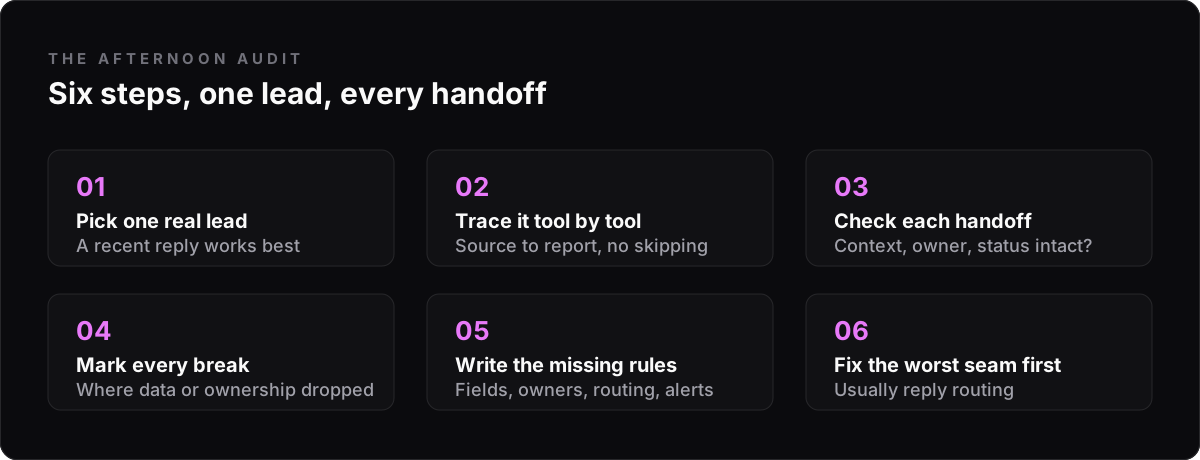
To audit a GTM workflow, trace one real lead through every tool in route order — source, enrichment, outbound, CRM, alerts, reporting — and check at each handoff whether context, owner, and status survived. Mark every break, write the missing rule for each, and fix the highest-severity seam first. Budget about four hours.
You don’t need six weeks or a consultant to find out where your workflow leaks. You need one real lead, access to your own tools, and an afternoon of honest tracing. This is the same method a professional workflow audit applies with more depth — run it yourself first and you’ll know whether the deeper version is worth paying for.
Before you start
- Access to every tool in the route (source, enrichment, sequencer, CRM, Slack, reporting sheet)
- One lead that recently replied to outbound — not a hypothetical
- A blank doc for the route map, and ~4 focused hours
Step 1 Pick one real lead
10 minutes
Choose a single lead that recently replied to outbound — replies exercise every handoff. Note where it first entered your stack: an Apollo search, a scraped list, an inbound form, or a partner sheet.
Resist auditing “the workflow” in the abstract. One concrete lead forces every gap into the open, because you have to answer “what happened next?” with evidence instead of the diagram in your head.
Step 2 Trace it tool by tool
45–60 minutes
Open each tool in route order — source, enrichment, sequencer, CRM, alert channel, report — and find this exact lead in each one. Screenshot what each tool believes about it.
You're collecting each system's version of the truth: which fields are filled, what stage or status it shows, who owns it, and what touched it last. Differences between tools are the audit.
Step 3 Check the six handoffs
45 minutes
At each seam — source→enrichment, enrichment→outbound, outbound→CRM, CRM internal, alerts, CRM→reporting — ask three questions: did the context survive, is the owner still clear, and is the status current?
Use a simple pass/fail per seam. A handoff passes only if a teammate could pick the lead up cold at that point and know what it is, whose it is, and what happens next.
Step 4 Mark every break
20 minutes
Write down each point where context, ownership, or status dropped — what was lost, which tool it died in, and who had to fix it manually (if anyone noticed at all).
Severity matters: a missing nice-to-have field is low; an unrouted positive reply or an opted-out contact still in sequence is high. Rank the breaks before you think about fixes.
Step 5 Write the missing rules
45 minutes
For each break, write the rule that should have caught it: the required fields at intake, the field's system of record, the reply-routing path, the alert trigger, or the reporting definition.
A rule names a decision, not a tool: “every accepted lead carries source, ICP fit, and owner” or “positive replies create a CRM task for the owner within the hour.” If you can't write the rule, the handoff was never defined.
Step 6 Fix the worst seam first
ongoing
Pick the highest-severity seam — for most outbound teams it's reply routing — and implement its rules inside the tools you already run before touching anything else.
One cleaned seam builds the muscle and proves the value. Resist the rebuild instinct: the audit usually shows the tools are fine and the decisions between them were never made.
What “good” looks like at each handoff
Use this as the pass/fail key for step 3. A seam passes when the answer to all of its checks is yes — for the full breakdown of why each seam fails, see the six GTM handoffs where pipeline leaks.
Lead Source
Source label, ICP fit, owner, and a rejection path on every accepted lead
Enrichment
Required fields filled, fallbacks defined, confidence rules written down
Outbound
Send status, reply type, bounces, and opt-outs leave the tool automatically
CRM
One system of record per field; stages, attribution, and ownership current
Alerts
Priority events reach the owner with context attached — and nothing else alerts
Reporting
Source quality, reply outcomes, and gaps readable in one view, no exports
When to bring in help
If the afternoon audit surfaces one or two breaks, fix them yourself with the rules from step 5. If it surfaces breaks at most seams — or the same breaks keep returning after you fix them — the workflow needs its decision layer rebuilt, not another patch. That’s the job of a focused cleanup sprint: audit, map, clean, and hand off the operating rules in 10–14 days, on the stack you already run.
Shortcut
Want the two-minute version first?
The Handoff Health Check asks six questions — one per seam — and scores your route before you spend the afternoon.
Get the next field note
One practical note on GTM handoffs when it's published. No volume, no fluff.
No list-blasting. A short, useful sequence — unsubscribe any time.