

The short answer
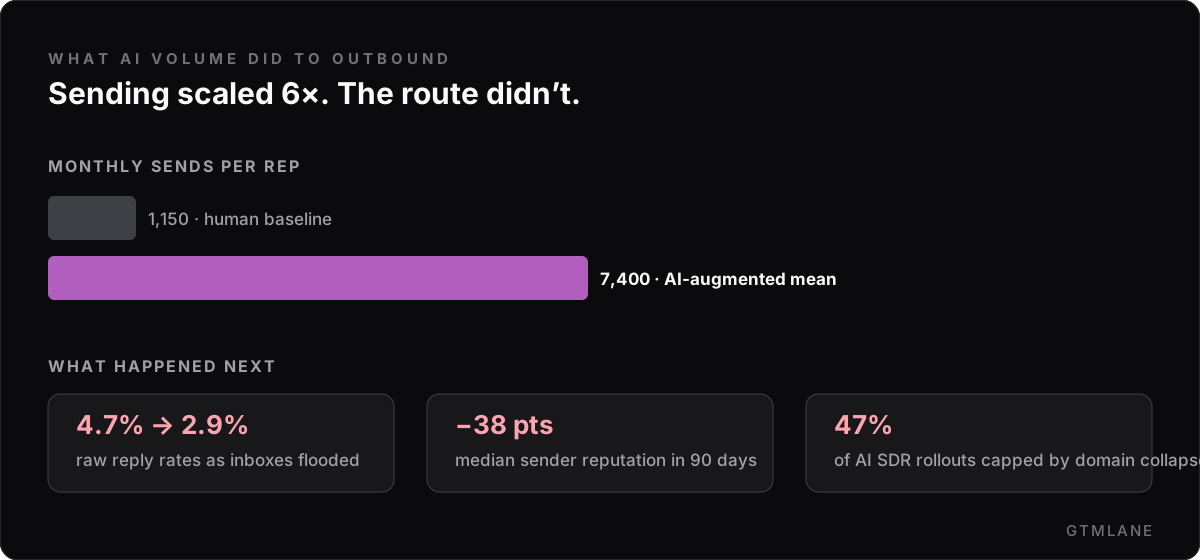
AI SDRs multiplied outbound volume roughly six-fold while reply rates fell from 4.7% to 2.9% and nearly half of deployments hit domain-reputation collapse within 90 days. The bottleneck in outbound has moved: not generating activity, but routing it — keeping context, owners, suppression, and reporting intact at AI speed. Volume is now cheap. The route is the constraint.
The pitch was irresistible: an AI SDR that prospects, writes, and sends around the clock, replacing headcount with software. Two years of real deployments later, the data tells a more specific story — not that the tools are useless, but that they attack the part of outbound that was never the constraint, and overload the part that was.
What the 2026 data actually shows
Aggregated deployment data published this year is unusually consistent. Per-rep monthly volume jumped from a human baseline around 1,150 sends to an AI-augmented mean near 7,400. Over the same period, raw reply rates fell from 4.7% to 2.9% as templated AI outreach became recognizable and inboxes saturated. Deliverability paid the bill: a median 38-point sender-reputation drop within 90 days of scaling agentic volume, and 47% of attempted AI SDR deployments capped by domain-reputation collapse in their first quarter — with Microsoft 365 inboxes filtering hardest.
The category’s credibility took its own hits — TechCrunch reported one heavily-funded vendor listing customers it didn’t have, and regulators settled a string of AI-marketing-claims actions. The market response by mid-2026 is visible in where the money moved: away from autonomous cold sending, toward orchestration — tools that coordinate signals, routing, and follow-up rather than just multiplying messages.
Why volume breaks the route, mechanically
Every problem we’ve catalogued in the six handoffs gets multiplied by send volume:
Intake
An AI agent sourcing its own leads means weak records enter at machine speed. Without intake rules, you're enriching and emailing lists no human ever sanity-checked.
Suppression
Opt-outs and bounces logged in one tool but not propagated used to burn a few sends a week. At 7,400 sends per rep, a broken suppression handoff is a compliance incident and a deliverability spiral.
Reply routing
More sends produce more replies in absolute terms even at lower rates — and AI-generated interest still needs a human answer fast. Replies sitting untriaged for three days now happen at 6× the rate.
CRM truth
Agents writing activity into the CRM without field contracts produce duplicates and stage drift faster than any team can clean manually.
Reporting
When volume jumps 6×, leadership immediately asks what it's producing. If reporting was already a Monday rebuild, it now answers a week late, about ten times more activity.
The takeaway isn’t “avoid AI”
Used inside a clean route, AI genuinely compresses work — enrichment, drafting, research, triage suggestions. The failure pattern is sequencing: teams bolt an AI sender onto a workflow whose handoffs were already leaking, and the leak scales with the volume. The teams getting results in 2026 did it in the opposite order — fixed the route first (intake rules, field contracts, reply routing, suppression, reporting), then added AI throughput on top of rails that hold.
A practical sequence: run the two-minute Handoff Health Check on your current route. If it’s leaking at human volume, it will break at AI volume — clean it first, then scale the sending.
Sources
- Digital Applied — AI SDR statistics: 100+ outbound data points (2026)
- Digital Applied — the case against AI SDRs: contrarian analysis
- Unify — best AI SDR software 2026 (and why you might not need one)
- Prospeo — AI SDRs: what works, what fails (2026)
- TechCrunch — reporting on 11x customer-claim controversy (March 2025)
- OneAway — AI SDR tools: an honest review
Figures reflect the cited analyses’ datasets and windows; treat them as directional benchmarks rather than guarantees for any single stack.
Before you scale sending
Find out if your route can carry AI volume.
Get the next field note
One practical, sourced note on GTM handoffs when it's published. No volume, no fluff.
No list-blasting. A short, useful sequence — unsubscribe any time.