
The short answer
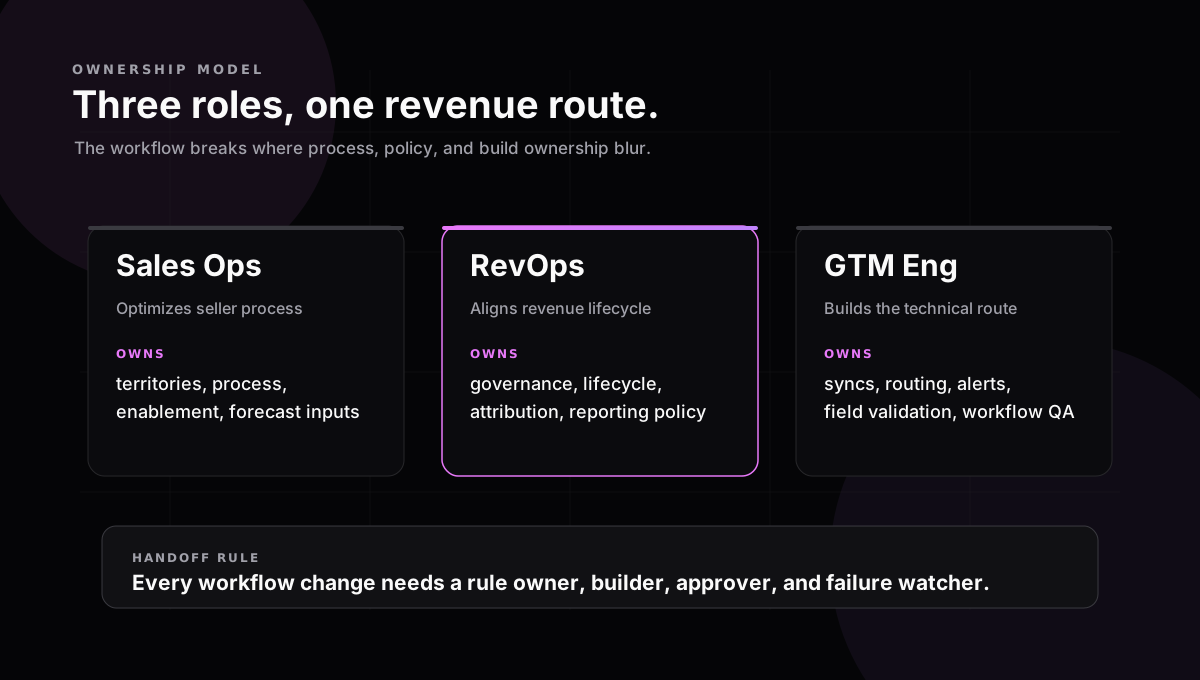
Sales Ops optimizes the seller operating system. RevOps aligns the full revenue lifecycle across marketing, sales, and customer success. GTM engineering builds the technical route that moves records, fields, events, alerts, and reports between tools. The cleanest teams name one owner per handoff instead of treating the workflow as everybody’s side job.
The titles overlap because the work overlaps. A positive reply touches sales process, lifecycle policy, CRM data, and integration logic in the same moment. If nobody has named which team owns which part, the reply waits in a sequencer tab while everyone assumes someone else saw it.
That is why the useful distinction is not philosophical. It is operational. When a lead crosses a tool boundary, who defines the rule, who builds the rule, who approves the change, and who watches for failure? The answer is the operating model.
The simple role map
Sales Ops
How do sellers work better?
Typical artifacts: Territory rules, compensation inputs, sales process, enablement, forecast hygiene.
RevOps
How does the revenue lifecycle work across teams?
Typical artifacts: Lifecycle definitions, governance, pipeline policy, attribution, cross-functional reporting.
GTM engineering
How does the route actually move records and events?
Typical artifacts: Enrichment pipelines, sync rules, routing logic, alerts, workflow QA, data contracts.
Sales Ops and RevOps are mature enough that most teams already know they need them. GTM engineering is newer because the modern stack made the space between tools programmable. Clay’s GTM engineering guide describes the role around building automated workflows, enrichment, integrations, and repeatable GTM systems. That work is real even when the title is not present.
The ownership matrix
Use this matrix as a starting point. The exact names may change by company size, but the split should stay clear: business process, revenue policy, and technical route are different responsibilities.
| Surface | Sales Ops | RevOps | GTM Eng |
|---|---|---|---|
| Seller process | Primary | Contributes | Supports with automation |
| Revenue lifecycle | Sales portion | Primary | Builds lifecycle logic |
| Field definitions | Needs clean inputs | Owns governance | Implements mapping and validation |
| Tool integrations | User requirements | Approves process impact | Primary build owner |
| Reply routing | Defines seller action | Defines lifecycle impact | Builds event route |
| Alerts and exceptions | Defines what reps need | Defines severity | Builds detection and delivery |
| Reporting | Sales productivity lens | Primary revenue lens | Builds trustworthy inputs |
| Workflow handoffs | Owns seller-side handoffs | Owns cross-team policy | Builds and tests the route |
Where handoffs create confusion
Handoffs create confusion because they combine three kinds of questions. A process question: what should the seller do next? A policy question: what should the CRM now believe about lifecycle, attribution, and stage? A build question: how does the event move, validate, alert, retry, and report?
Consider a positive reply. Sales Ops may define the rep action: respond, create a task, move to the right sequence exit. RevOps may define lifecycle impact: update status, preserve source, prevent duplicate opportunities, protect attribution. GTM engineering builds the event route: classify the reply, write to the CRM, notify the owner, catch failures, and make the event visible in reporting.
When those decisions are not separated, the team gets tool-shaped debates. One person asks whether Smartlead can sync replies. Another asks whether HubSpot should own the stage. Another asks whether Slack is too noisy. All three are valid, but the real question is the handoff contract.
Do you need a GTM engineer, or GTM engineering work?
The answer depends on volume and change rate. You need a full-time GTM engineer when the business is continuously launching motions, changing data sources, building enrichment logic, and testing workflows. You need GTM engineering work when the existing route is broken but the decisions are mostly one-time: field mapping, reply routing, sync rules, alerts, and reporting cleanup.
That distinction matters for lean teams. Hiring a technical role to make a few durable workflow decisions is expensive. Ignoring the work because the title sounds advanced is also expensive. A focused GTM Workflow Handoff Sprint exists for the middle ground: audit the route, clean the breaks, document the rules, and hand the workflow back to the team.
A lightweight operating model
If you do not have all three functions, assign the responsibilities explicitly anyway. Every workflow change should name four things: the business rule owner, the technical builder, the approver, and the failure watcher. The same person can hold more than one seat, but the seats should not be invisible.
- Business rule owner: defines what should happen and why.
- Technical builder: implements the route in tools, APIs, or automation.
- Approver: confirms the rule matches lifecycle and reporting policy.
- Failure watcher: reviews alerts, sync errors, and reporting gaps after launch.
This is the practical version of role clarity: every handoff has a named rule, a named builder, and a named watcher. Without that, process diagrams become ceremony and the actual workflow remains tribal knowledge.
Sources
- Clay — GTM engineering: what it is and how to hire
- Salesforce — sales productivity research and State of Sales
- HubSpot — What is a go-to-market strategy?
- ZoomInfo — GTM tech stack essentials
Get the next field note
One practical, sourced note on GTM handoffs and GTM engineering when it's published.
No list-blasting. A short, useful sequence — unsubscribe any time.